Three Tests and a Logbook: What Getting Your Driver’s Licence in Queensland Actually Involves
Most people think getting a driver’s licence in Queensland is one test. It’s three — plus a hundred hours of homework. Here’s the whole thing, in order, with the traps that catch people out.
Ask anyone who’s been driving for twenty years how you get a licence in Queensland and they’ll tell you about “the driving test.” Singular. That was roughly true in 1998.
Today there are three separate tests between you and a P1 licence, and one of them didn’t exist five years ago. There’s also a hundred-hour logbook requirement sitting in the middle of it that takes most people the better part of a year.
None of it is hard. But the order matters, some of the gates have waiting periods attached, and every week we meet learners who’ve hit one of them and lost a month they didn’t need to lose.
So here’s the whole pathway, start to finish.
The short version
| Stage | What it is | When you can do it |
|---|---|---|
| 1. Road rules test | PrepL online, or a written test at a service centre | From 16 (enrol in PrepL from 15 years 11 months) |
| 2. Your learner year | 100 logbook hours, including 10 at night | Straight after you get your Ls |
| 3. Hazard perception test | Online, ~15–30 minutes | After 6 months on your Ls |
| 4. Practical driving test | Q-SAFE, ~45 minutes | After 12 months on your Ls, and from age 17 |
The earliest anyone can hold a P1 licence in Queensland is 17 — and only if they got their Ls the day they turned 16 and did everything on schedule.
Stage 1: The road rules test
Before you can drive at all, you need to prove you know the rules. You’ve got two ways to do it.
PrepL — the online option
PrepL is Queensland’s online learning-and-test program, and it’s the way most people go now. It’s not just a quiz: it teaches as it goes, and TMR says it takes “around 4-6 hours to complete.” You don’t have to do it in one sitting — you get 12 months from enrolment to finish, and you work at your own pace.
At the end there are 30 multiple-choice questions, and you need 90% — that’s 27 out of 30.
The bit worth knowing: you can enrol from 15 years and 11 months old. Do that, and you can walk into a service centre on your sixteenth birthday and walk out with your learner licence the same day. We’ve had students do exactly this. It’s the single easiest month you’ll ever save.
The written test — the in-person option
If you’d rather sit a traditional test, you can do that at a transport and motoring customer service centre. It’s also 30 questions, but it’s scored in two parts, and this is where people come unstuck:
- 9 out of 10 on the give-way questions, and
- 18 out of 20 on road rules and licence requirements
You have to pass both sections. Get 20/20 on general road rules and 8/10 on give-way and you’ve failed — which is a rough way to find out that give-way rules are the thing Queensland actually cares about.
You can only sit the test once a day, and you pay each time. Once you pass, the result is valid for 5 years.
Our honest take: do PrepL. It’s more forgiving, you can do it from your bedroom, and the material sticks better because it teaches before it tests.
Stage 2: The learner year
You’ve got your Ls. Now comes the long part.
The rules you’re driving under
While you’re on your learner licence you must:
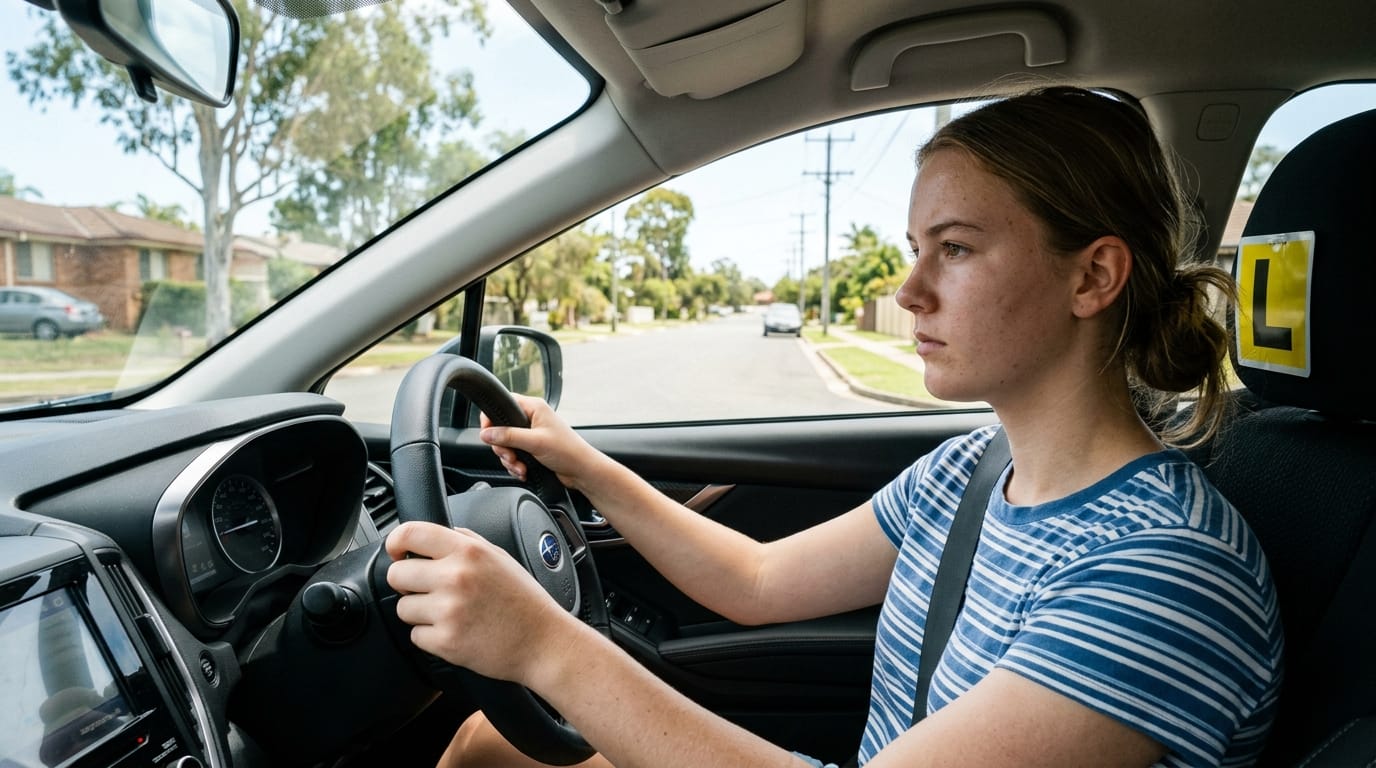
- Display L plates front and rear — at least 14.6cm × 14.6cm, black L on yellow, visible from 20 metres
- Have a supervisor beside you — “someone who holds a valid open licence for the class of vehicle you are driving and has held the licence for at least 1 year”
- Comply with the no alcohol limit — zero, not 0.05
- Carry your learner licence every time you drive
The mobile phone rule people get wrong
If you’re under 25, you cannot use a phone while driving at all. Not hands-free. Not Bluetooth. Not a wireless headset. Not loudspeaker.
And here’s the part almost nobody knows: your supervisor and your passengers can’t use a phone on loudspeaker while you’re driving either. Mum taking a call on speaker from the passenger seat is a fine and 4 demerit points — and 4 points in 12 months on your Ls means a 3-month suspension.
Tell your parents. Genuinely, tell them.
The 100 hours
If you’re under 25, you need 100 hours of supervised driving, including 10 hours at night (between sunset and sunrise), recorded in your learner logbook — the paper one or the app.
If you’re 25 or over, you don’t need to submit a logbook at all. You still need the practice; you just don’t have to prove it.
A hundred hours sounds enormous. It’s about two hours a week for a year. The people who struggle aren’t the ones who find it hard — they’re the ones who don’t start until month eight and then try to cram it.
The shortcut that’s completely legitimate
Here’s the part that isn’t widely known, and it’s worth real money and real time:
“Every hour of your daytime driving with an accredited trainer counts for 3 hours in your logbook—up to a maximum of 10 actual hours or 30 logbook hours.“
Ten hours of professional lessons gets you 30 of your 100 hours. Nearly a third, taught properly, by someone whose job is spotting the habit you can’t see yourself.
Two things to get right:
It only counts with an accredited driver trainer. Queensland accreditation means an approved training course, a clean licence history, a blue card, and a current Industry Authority card. Your uncle who’s “basically a driving instructor” is not an accredited driver trainer.
Don’t waste it at night. A night-time lesson with a trainer counts as either triple time or night hours — not both. Your 10 night hours can’t be tripled by anyone. So do your bonus lessons in daylight, and bank your night hours with your supervisor on the drive home from training.
Stage 3: The hazard perception test
This is the one that surprises people, because a lot of parents have never heard of it.
Since 1 July 2021, you must pass the hazard perception test before you can book your practical driving test. It’s not optional and there’s no way around it.
It’s an online test — you pay a fee, get access for up to 12 months, and sit it whenever you’re ready. TMR says it takes “approximately 15 to 30 minutes.” You watch real driving footage and respond when you spot a hazard developing. It’s testing judgement, not reflexes: not “can you see the car”, but “do you understand that the car is about to become your problem.”
The gate that costs people a month
You must have held your learner licence for at least 6 months before you can take the hazard perception test.
Read that again, because here’s how it plays out. Someone turns 16 in January, gets their Ls, knocks over their 100 hours by September because they’re keen, and books their practical test — only to discover they can’t book it, because they haven’t passed the HPT, and they’re scrambling to fit it in.
That’s the good version. The bad version is the person who books a practical driving test without having passed the HPT at all, turns up, and is turned away. The test is cancelled and the fee is not refunded.
Do it at the six-month mark. Not when you’re ready for your practical — at six months, the day you’re eligible. It’s online, it’s quick, and having it done removes a hard stop from your calendar.
Stage 4: The Q-SAFE practical driving test
The main event. In Queensland it’s called Q-SAFE, and it’s more structured than most people expect.
What to bring
- Proof of identity and your current learner licence
- Your completed logbook, if you’re under 25
- Glasses or contacts, if you need them to drive
- The registration number of the car you’re using
- Closed shoes
Arrive 20 minutes before your appointment. Turn up late, or turn up in an unsuitable car, and the test is cancelled with no refund.
What the car has to be
For a class C test, your vehicle must be a maximum of 4.5t GVM, built or fitted to carry no more than 12 adults including the driver, currently registered and roadworthy, with L plates correctly displayed. Working lights, horn, doors, mirrors, windows, wipers, seatbelts, head restraints and parking brake, and at least 1.5mm of tyre tread.
How the test runs
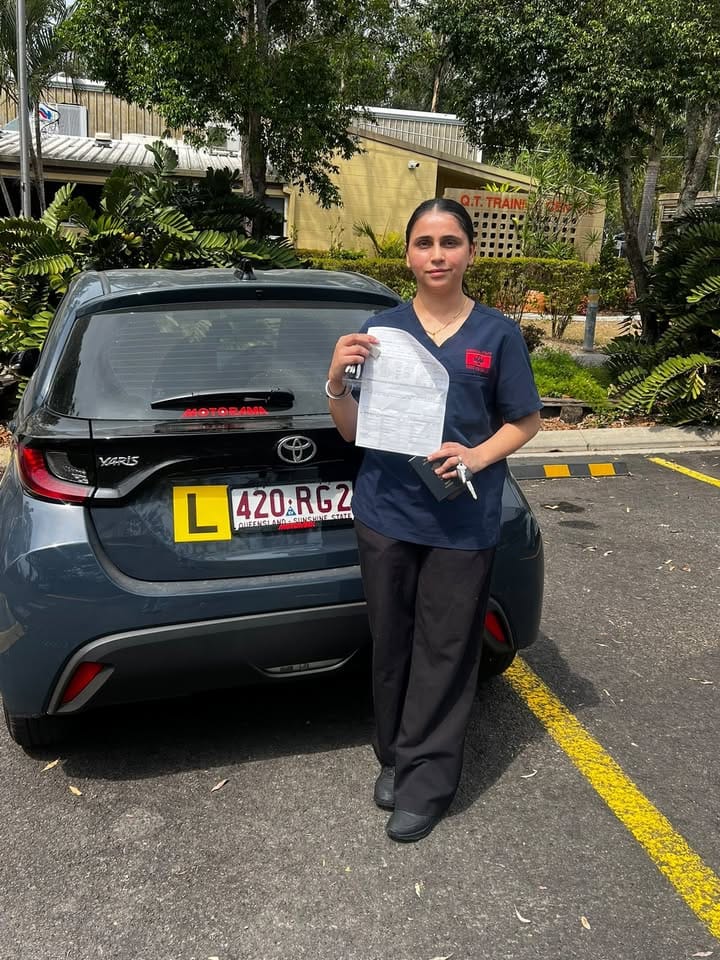
A class C test is about 45 minutes door to door, with 25–35 minutes of actual driving. It goes:
- Vehicle safety check — the examiner checks the car is fit to test in
- Pre-drive check — you’re asked to find and explain two controls. Mirrors, headlights, wipers, washers, demister, air conditioning, hazard lights, seat adjustment. Getting one wrong here is a minor error, not a fail
- On-road driving — directed driving across a required mix of conditions: multi-lane roads with lane changes, roundabouts, T-intersections and crossroads, traffic lights, stop and give-way signs, higher-speed roads (80km/h+), lower-speed zones, pedestrian and children’s crossings, merging and exiting
- Two manoeuvres — chosen by the examiner from reverse park, three-point turn, U-turn, hill start, or a straight reversing exercise. At least one will involve reversing
- Debrief — your result, and what the examiner saw
During the drive, the examiner gives you tasks and expects you to complete them while following the road rules. They can’t answer questions that might influence your driving, and they won’t ask you to do anything illegal or unsafe. If an instruction seems wrong, it isn’t — follow it.
How you’re actually scored
This is the part worth understanding, because it changes how you should drive on the day.
Non-critical driving errors are individual mistakes that don’t compromise safety. You’re allowed a number of these. One clunky gear change does not fail you.
Specific repeated driving errors are what happens when you make the same non-critical error enough times. This is the one that quietly ends most tests — not one bad moment, but the same habit showing up at every second intersection. Consistently rolling the stop sign. Never quite checking the blind spot. It’s the repetition that fails you.
Critical driving errors end the test on the spot. There are four general ones:
- Intervention — the examiner has to take control to prevent something unsafe
- Collision — you hit something
- Dangerous action — anything creating serious risk to another road user
- Disobeying an official direction — not following the examiner’s instruction
If one of these happens, the test stops and you’re directed back to the testing centre by the shortest safe route.
If it doesn’t go your way
You can re-sit the next day after a first attempt, after 8 days following a second, and after 29 days following a third or subsequent attempt. You pay a fee each time.
Most people who fail, fail on a repeated error — which is exactly the kind of thing a couple of hours with an instructor will find, because you cannot see your own habits from the driver’s seat.
Automatic or manual — decide before you book
The car you’re tested in decides what you’re licensed to drive, permanently.
Pass in an automatic and your Queensland licence is issued as class CA — automatic vehicles only. Pass in a manual and you can drive both.
If you’re later issued an automatic-only licence and want to drive a manual, there’s no form and no fee waiver. You sit the whole practical driving test again, in a manual, at full cost.
For a young driver, that’s a decision worth making properly. Work utes, tradie vehicles, hire cars overseas, a cheap first car from a mate — a lot of them are manual.
After you pass
You’ll be issued a P1 licence. To get one you must be 17 or older, have held your learner licence for at least 1 year, completed your logbook hours if under 25, and passed both the hazard perception and practical tests.
P1 conditions: zero alcohol. Red P plates. No mobile phone for any reason while driving (if you’re under 25). No more than one passenger under 21 who isn’t immediate family between 11pm and 5am. No high-powered vehicles. And you can’t supervise a learner.
You hold P1 for at least a year, then move to P2.
If you’re 25 or over, you skip P1 entirely and go straight to P2 once you’ve met the other requirements.
The five-minute version
- Enrol in PrepL at 15 years and 11 months. Free month.
- Start your logbook in week one. Not month eight.
- Sit the hazard perception test the day you hit six months. It’s a hard gate on your practical test booking.
- Use your 10 hours of accredited lessons in daylight. That’s 30 logbook hours you don’t have to drive.
- Learn manual if there’s any chance you’ll need it. Changing later means sitting the whole test again.
Ready to get started?
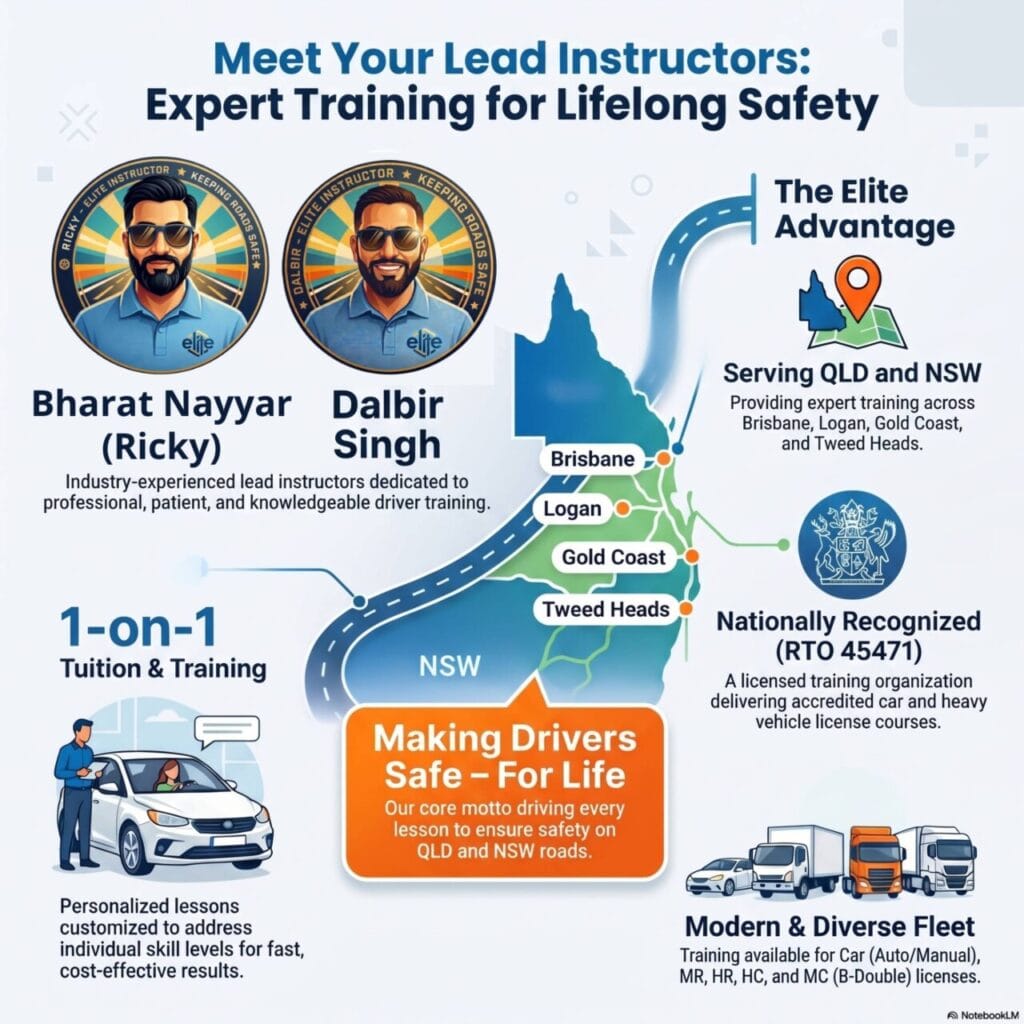
Elite Truck and Car School has been teaching Queensland drivers out of Logan since day one — automatic and manual, dual-control cars, male or female instructors, pick-up from home, work or school.
Every hour with an accredited trainer is three hours in your logbook. Ten hours with us is thirty hours of your hundred.
Call Ricky on 0432 453 553, Monday to Saturday, 8:00am–5:00pm.
📍 3/40 Loganlea Road, Waterford West QLD 4133 🌐 etacs.com.au ✅ RTO 45471 · Logan QLD · Tweed Heads NSW
Making Drivers Safe — For Life
#EliteTruckAndCarSchool #ETACS #TruckDriving #HeavyVehicleLicence #MCLicence #HCLicence #HRLicence #MRLicence #TruckLicence #RoadRanger #TLIC4006 #DrivingSchool #TruckSchool #LoganQLD #WaterfordWest #Beenleigh #Brisbane #GoldCoast #TweedHeads #Ipswich #TransportCareers #LogisticsJobs #TruckiesOfAustralia #ChainOfRespo